

What Is Pop in Pickleball? Paddle Pop Explained
What Is Pop in Pickleball? Paddle Pop Explained (and Whether You Actually Want More of It)
If you have been shopping for a paddle, you have seen the word everywhere: this one has "great pop," that one is "poppy but controllable." So what is pop in pickleball, exactly? Pop is how much speed the ball leaves your paddle with on a short, compact swing - a volley, a counter, a punch, a speed-up. It is the paddle doing work for you when you do not have time to take a full swing.
That is the whole definition. The reason the word causes so much confusion is that people use "pop" and "power" as if they were the same thing, and they are not. Power is what you get on a full swing - a drive from the baseline, a serve. Pop is what you get when you barely swing at all. A paddle can have plenty of one and not much of the other, and knowing which one you actually need will save you from buying the wrong paddle twice, which is roughly what I did.
Below is what creates pop, how it trades off against control, who should want more of it, and a few simple tests you can do in a demo session that tell you more than any spec sheet.
Watch: How Fast Are the Luzz Paddles? | First Data Radar Gun Test - Johnkew Pickleball
Pop vs Power - They Are Not the Same Thing
Think about where each one shows up in a game.
Power lives at the baseline. Serve, return, third-shot drive. You have time, you take a full swing, and the ball speed comes mostly from your arm and body. A heavier paddle with more mass out toward the tip (high swing weight) helps here because it carries more momentum through the ball - what people call plow-through.
Pop lives at the kitchen line and in hand battles. Someone speeds up at your chest, and you have maybe a quarter of a second to block or counter. There is no backswing. The ball speed you get back comes from how the ball rebounds off the face, not from your swing. That rebound is pop.
Here is why the distinction matters: some of the most popular "power" paddles are heavy, high-swing-weight paddles that drive like a truck but feel slow in a hand battle. And some thinner, lighter paddles that would never win a serve-speed test are absolutely lethal at the kitchen because the ball jumps off them with almost no effort. If you play mostly rec doubles, you spend far more points at the kitchen line than the baseline, and pop is the spec that matters more.
What Actually Creates Pop in a Paddle
Four things, roughly in order of how much they matter.
Core thickness. This is the big one. A 14mm core (or thinner) is stiffer and returns more energy to the ball - more pop. A 16mm core flexes slightly more on contact, which gives you more dwell time and a softer, more controllable feel, but takes some pop away. If you only remember one thing from this article: thinner core equals more pop, thicker core equals more control.
Construction. Thermoformed (unibody) paddles, where the face is molded around the core and the edges are foam-injected, are noticeably poppier than older cold-pressed builds. The whole paddle is stiffer, the sweet spot is bigger, and the edges do not deaden the ball. The newer full-foam-core paddles (often called Gen 3) push this further - the ball comes off them even faster, especially on off-center hits.
Face material. Raw carbon fiber faces tend to feel slightly more muted and grippy for spin. Fiberglass faces are more lively and springier - more pop, less control, less spin. Most paddles you would want in 2026 are carbon, so this matters less than it used to, but it is worth knowing when a paddle feels unexpectedly bouncy.
Weight and balance. A paddle that is lighter and balanced toward the handle feels quicker in your hand - you can get it into position faster in a firefight, which people often describe as "pop" even though technically it is hand speed. Swing weight and twist weight (how stable the paddle is on off-center hits) affect this feel more than raw static weight. The video above is a good example of how reviewers measure these: John Kew clocks the Luzz Cannon, Inferno, and Tornazo at almost identical serve speeds, but the spec breakdown shows they get there with different swing weights and balance points, which is why they feel different in your hand.
One more thing that is not the paddle at all: the ball. Outdoor balls are harder and pop more; indoor balls are softer and absorb more. If you test a paddle indoors and then play outdoors, it will feel poppier than you remember.
The Trade-Off: Pop vs Control
Everything that adds pop takes a little control away. That is not marketing, that is physics. A face that returns more energy to the ball also returns more of your mistakes.
The place you feel it most is the reset. You are in the transition zone, someone drives at your feet, and you need to soften the ball into the kitchen. With a control paddle, the ball sits on the face a fraction longer and you can absorb the pace. With a high-pop paddle, that same block comes off hot and floats to the top of the net where it gets put away.
The second place is the dink. A poppy paddle wants to hit the ball a little deeper than you intend. Players who switch to a high-pop paddle almost always go through a week or two of popping dinks up and having them attacked, until their hands recalibrate.
I went through exactly this. My paddle history is a fairly typical amateur one: I started on a soft control paddle, got tired of my counters dying in the net, switched to something with a lot more pop, and immediately started losing kitchen battles I used to win because everything I blocked sat up. The pop was real. My hands just were not ready for it yet. What fixed it was not switching paddles back - it was learning to hold the paddle looser and take the swing out of my resets, which I probably should have been doing anyway.
If you are the kind of player who already struggles to keep the ball low at the kitchen, adding pop makes the problem worse before it makes anything better. If you are a player whose counters are consistently a little slow and a little short, pop is the cheapest improvement you can buy.
Who Should Want More Pop
You probably want a poppier paddle if:
You play at the kitchen line a lot and lose hand battles you feel you should win. Your blocks come back slow and your counters do not do enough damage.
You have a compact swing. Some players, especially former tennis players, naturally hit with a short, punchy stroke. Pop rewards that.
You do not generate much racquet-head speed. Older players and players with shoulder or elbow issues often get more from a poppy paddle than from trying to swing harder. The paddle supplies the speed.
You play mostly outdoors with a hard ball and your game is built around speed-ups and counters.
You probably want less pop if:
You are still learning to dink and reset. A control paddle is more forgiving of a tight grip and a slightly too-big swing, which is every beginner.
Your pop-ups are already your biggest problem. More pop equals more pop-ups until your hands catch up.
You are a driver who wins from the baseline. You want swing weight and plow-through, which is a different spec.
The honest answer for most 3.5 to 4.0 players is a middle-ground paddle: 16mm thermoformed carbon. Enough pop to counter with, enough dwell time to reset with. The thin, full-foam rockets are fun to demo but they punish sloppy hands, and most of us have sloppy hands more often than we admit.
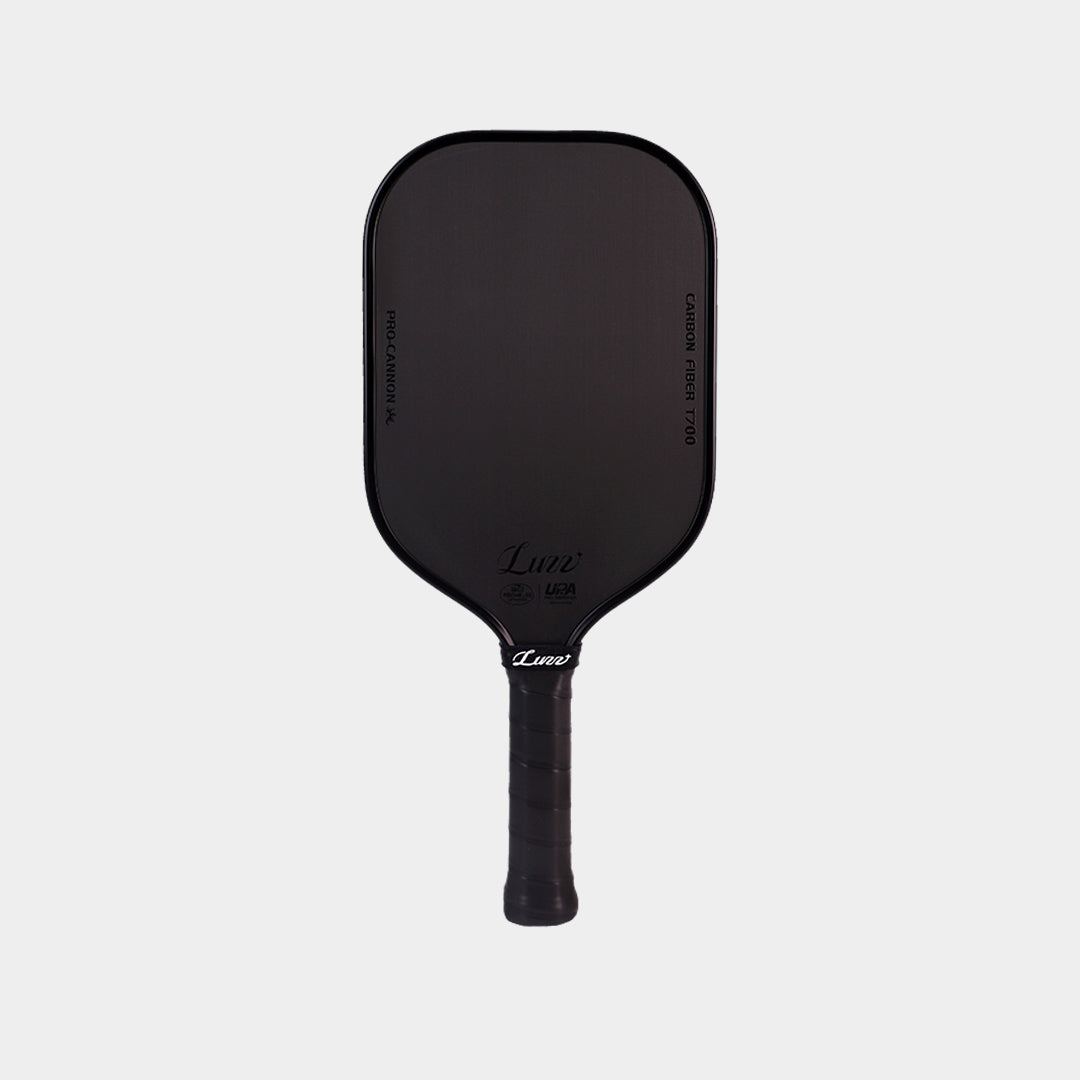
The paddle I have been playing with is from Luzz. The Cannon is a thermoformed 16mm carbon paddle that sits right in that middle ground - real pop on counters and speed-ups without the reset feeling like a trampoline - and it costs a fraction of what the big brands charge for the same construction.
How to Test for Pop Before You Buy
Spec sheets tell you the core thickness. They do not tell you how a paddle feels in your hand. Here are three tests you can do with a demo paddle in ten minutes.
The bounce test. Hold the paddle flat and drop a ball on the face from about waist height. Watch how high it comes back. Do this with two or three paddles side by side and the difference is obvious - the poppier paddle bounces the ball noticeably higher. It is crude, but it correlates surprisingly well with how the paddle plays.
The hand-battle test. Stand at the kitchen with a partner and just volley at each other, gradually speeding up. Pay attention to two things: how much effort it takes to send the ball back with pace, and how often your block sails long or pops up. A high-pop paddle makes the first easy and the second frequent.
The reset test. Have your partner drive at you from the baseline while you stand in the transition zone. Try to drop the ball into the kitchen. If you cannot get the ball to die, even with a soft grip, the paddle may have more pop than your game can handle right now. That is not a knock on the paddle; it is information about the match between it and you.
If you can, do these tests with the ball you actually play with. And do them on a day when your hands are fresh - fatigue makes every paddle feel poppy.
A Note on Paddle Rules and Pop
Pop has become enough of an arms race that USA Pickleball now tests paddles for how much rebound they produce, using a measurement of the paddle-ball coefficient of restitution, and paddles that exceed the limit are not approved for sanctioned play. That is why you sometimes see a paddle described as "delisted" or "not approved" even though it plays great. If you play tournaments, check the approved list before buying the poppiest thing you can find. For rec play, it does not matter - but it is a useful signal that the industry itself thinks pop has an upper limit worth enforcing.
Key Takeaways
Pop is the ball speed you get with a short swing - blocks, counters, speed-ups - and it is a different thing from full-swing power. Thinner cores, thermoformed and foam-core construction, and lively face materials all add pop, and every one of them takes a little control away in exchange. Most kitchen-line players benefit from more pop than they think; most players still learning to reset benefit from less. Demo it, drop-test it, and try a real reset before you buy.
If you want the broader breakdown of paddle specs - swing weight, twist weight, core, face, and what each one changes - I wrote a full guide here: Pickleball Paddle Specs Explained.
Frequently Asked Questions
What does pop mean in pickleball?
Pop is how fast the ball rebounds off the paddle face when you use a short, compact swing, like a volley or a counter. It is a property of the paddle, not your stroke.
Is pop the same as power in a pickleball paddle?
No. Power is full-swing ball speed from the baseline, driven mostly by swing weight and your own swing. Pop is short-swing ball speed at the kitchen, driven by core thickness, construction, and face material.
Does a 14mm or 16mm paddle have more pop?
A 14mm paddle has more pop. The thinner core is stiffer and returns more energy to the ball. A 16mm paddle gives up some of that pop for more control and a softer feel.
Do beginners need a paddle with a lot of pop?
Usually not. Beginners are still learning to keep the ball low, and extra pop makes pop-ups worse. A 16mm control-leaning paddle is the safer starting point.
What is the pop meaning in pickleball reviews?
When reviewers say a paddle has "good pop," they mean the ball leaves the face quickly on volleys and counters without much effort. When they say it is "too poppy," they mean it is hard to control on dinks and resets.