

How to Hit a Drive in Pickleball: 5 Fixes From a Real Coaching Session
If you want to know how to hit a drive in pickleball that actually lands in, the answer is not more power. It is less. The drive was the weakest shot in my game for a long time - fast, flat, and wildly inconsistent - until a pro coach in Austin rebuilt it in a single lesson by making me swing slower, not faster.
Most players learn the drive backwards. They start with pace and try to add control later. That is why their drives sail long one rally and slam into the net tape the next. The fix is to start with shape - the low-to-high swing path that creates topspin - and let pace come back gradually once the ball is landing where you aim it.
This article walks through the five changes that fixed my drive: swing path, power level, footwork timing, upper body tension, and swing length. None of them require athleticism. All of them require you to un-learn something that feels natural.
Watch: I keep missing my DRIVES because of these 5 things - Backpaddle Pickleball
Why Most Pickleball Drives Miss
Here is the diagnosis my coach gave me in the first five minutes, and I would bet money it applies to your drive too: the swing is too fast for the shape it is trying to create.
A good pickleball drive is not a flat missile. It is a topspin shot. The topspin is what lets you swing aggressively and still keep the ball in the court, because the spin pulls the ball down after it crosses the net. To generate that spin, your paddle has to travel from low to high, brushing up the back of the ball.
When you swing at full speed, two things go wrong at once. First, the swing path flattens out - there is no time for the low-to-high shape, so you get a flat trajectory with no margin over the net. Second, your body tightens up, which kills the smooth acceleration that spin requires. The result is the classic drive miss pattern: long when you catch it clean, net when you do not, and almost never repeatable.
The counterintuitive truth my coach kept repeating: shape creates the pressure, not the speed. A 60 percent drive with real topspin is a harder ball to handle than a 100 percent flat one, because it dips at your opponent's feet instead of arriving at a comfortable volley height. Once I accepted that, every other fix fell into place.
Fix 1: Swing Low to High - Shape Beats Speed
The first change was pure swing path. Instead of muscling through the ball with a level swing, load the paddle low and finish high - up through your head, as my coach put it, rather than yanking across your body.
The image that worked for me: you are trying to draw a ramp up the back of the ball, not punch a hole through it. Start the paddle below the contact point, brush up the back of the ball, and let the follow-through rise naturally. You do not have to force the finish. If the path is right, the follow-through takes care of itself.
What you should feel is the ball rolling off the paddle with an arc - up over the net with visible shape, then dipping down into the court. What you should see is the ball landing deep but safely inside the baseline, even when you catch it a little off-center. That margin is the entire point. A flat drive needs perfect contact to stay in. A shaped drive forgives you.
Common mistake to avoid: trying to create topspin by flicking or rolling the wrist at contact. The spin comes from the whole swing traveling low to high, not from a last-millisecond wrist move. If your wrist is doing the work, you are back to being fast and inconsistent - just with extra steps.
Fix 2: Cut Your Power to 50-60 Percent
This one stung, but it worked immediately. My coach had me hit drives at a smooth 60 percent effort - and they instantly became more consistent and, weirdly, not much slower.
Here is why it works. At 50 to 60 percent effort, you have enough time to complete the full low-to-high shape, your contact point stays out in front, and your body stays in sequence. At 100 percent, everything compresses: the backswing rushes, contact drifts late, and the shape disappears. You are not actually trading much ball speed either, because a smooth, connected swing transfers energy far better than a tight, rushed one.
In my experience, the 60 percent drive also wins on strategy. Because it carries topspin, it dips as it reaches your opponent. That means they are volleying up from below net height, which produces the pop-up you actually wanted when you were swinging out of your shoes. The hard flat drive feels aggressive, but it often arrives at a comfortable height and comes back faster than you can reset.
Practical way to calibrate: hit ten drives at what feels like half power. If eight or more land in, add a little pace. The moment you drop below about seven of ten, you have found your ceiling for today - back off five percent and groove it there. Pace grows back on its own as the shape becomes automatic.
Fix 3: Keep Your Back Leg Planted Through Contact
This was the fix I did not see coming, and it might be the most important one on the list for anyone who came to pickleball without a tennis background.
I had been stepping through the ball as I hit it - driving off my back foot and letting it swing through toward the net at contact, the way it feels like an aggressive shot should work. My coach stopped me: keep the back leg where it is as you make contact. Load your weight, rotate, hit - and only then let the leg come through.
The reason is stability. When your back leg is moving at contact, your whole body is moving, and every drive inherits that noise. Head moving, contact point wandering, face angle changing - that was the real source of my uncontrollable misses. With the back leg planted, your base is still, your upper body rotates around a fixed center, and the contact becomes repeatable.
The step through still happens - it is just a consequence instead of a cause. As you finish the swing, your upper body keeps turning, and once it fully uncoils it naturally pulls the back leg forward into your next move toward the net. Think of it as the first step of your approach to the kitchen, not the finishing move of your swing.
If you take one thing to the court from this article, take this: load, plant, rotate, hit - then move.
Fix 4: Relax Your Upper Body
Tension is the silent killer of the pickleball drive, and it is the fix I am still working on months later.
When I focused hard on the mechanics - swing path, footwork, contact - my shoulders and arm would tighten up, and the swing turned stiff and disconnected. The upper body and lower body stopped working together. My coach's cue that finally landed: relax the elbow down, soften the wrist, and let the shape create the pressure. My best drive of the whole lesson came on the one swing where I consciously relaxed my wrist and arm completely.
There is real mechanics behind the feel. A relaxed arm allows the kinetic chain to work - legs and hips start the rotation, the torso carries it, and the arm and paddle get whipped through last. A tense arm interrupts that chain, so you end up arming the ball with a fraction of the easy power your body rotation was already producing. Relaxation is not the opposite of power. It is where the power comes from.
A checkpoint you can use mid-game: between points, notice your grip pressure. If you are strangling the handle at an eight out of ten, back it down to a four. Loose grip, heavy paddle head, smooth swing - the ball comes off hotter than when you squeeze, and the dwell time on the face gives you noticeably more control over direction.
Fix 5: Shorten the Backswing and Push Through the Ball
The last fix cleaned up what was left: less arm movement, more push through the contact zone.
My swing had a big loop in it - a long, C-shaped backswing borrowed from watching too much tennis. In pickleball you rarely have time for that, especially on a fourth-shot drive or anything hit off a fast return. The ball is on you quicker than a tennis groundstroke, and a long backswing means late contact, and late contact means the ball goes wherever it wants.
The correction: compact takeback, then push the paddle through the ball toward your target. My coach kept asking for more through it - toward him, rather than a fast swipe across the ball. That push lengthens the dwell time, the fraction of a second the ball stays on the paddle face. More dwell time means more spin, more direction control, and a heavier ball on the other side, all without adding swing speed.
For players like us who are not inventing a drive on the fly from years of tennis, this compact groove is the whole game: short takeback, brush up the back of the ball, push through toward the target, finish high. Boring to describe. Devastatingly consistent to play against.
When to Drive (and When to Drop Instead)
Fixing the technique only pays off if you pick the right balls to drive. The drive is a pressure shot, not a default.
Drive when the ball is above net height at contact, when you are balanced and behind the ball, and when your opponents are still moving toward the kitchen or have shown they volley from too upright a stance. A dipping topspin drive at an incoming player's feet is one of the highest-percentage pressure plays at the 3.5 to 4.5 level.
Drop instead when the ball is low and you would have to hit up on it, when you are stretched or off balance, or when both opponents are already set at the kitchen line. Driving a below-net-height ball at two planted players is donating a counterattack - the exact scenario my coach was steering me away from with the shape-over-speed approach. And the two shots work together: a credible drive makes your drop better, because opponents who fear the drive stand deeper and give your drop more room to land.
The drive-drop combination - drive the third, drop the fifth off their volley - is a staple pattern worth drilling once your drive is trustworthy. I have covered more patterns like this in the other strategy pieces on this site - you can read my full drop-or-drive framework here if you want to go deeper after this one.
How to Practice These Fixes
Do not try to install all five fixes in one session. Layer them the way the lesson did.
Session one is shape only. Stand at the baseline with a partner or machine feeding you deep balls, and hit drives at 50 percent focusing purely on the low-to-high path. Do not care where the ball goes beyond in or out. You are grooving a swing shape, not playing points.
Session two adds the lower body: load the back leg, plant it through contact, let it release forward after the finish. Ten drives, checking the back foot on every one. If it is sliding through at contact, slow down another notch until it stays.
Session three makes it game-real: drive and then drop. Have your partner feed a deep ball, drive it at 60 percent, then play the next ball as a drop off their volley and follow it in. This trains the honest pattern - drive to create the pop-up, drop to get to the kitchen - instead of the fantasy where every drive is a clean winner.
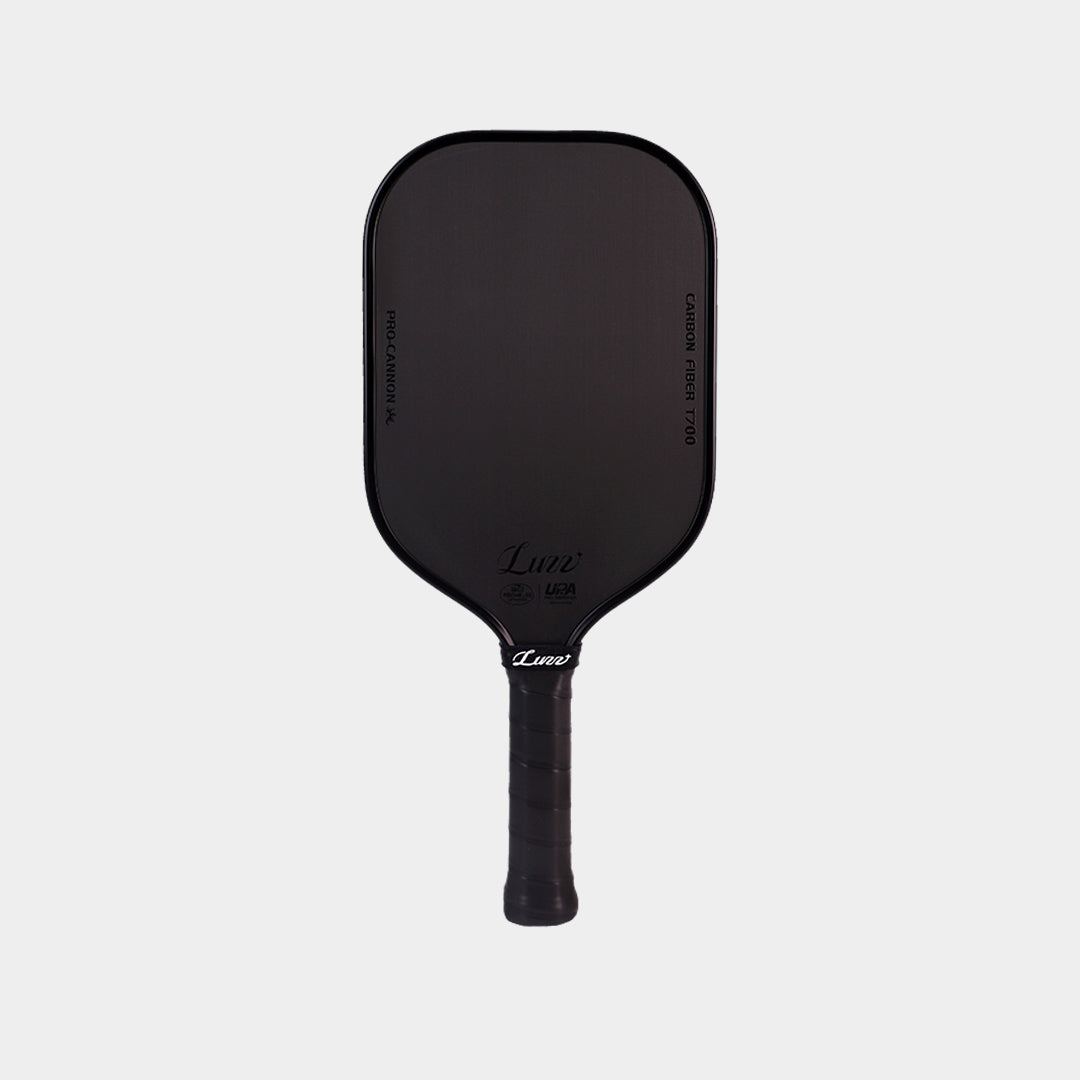
Equipment note, since it genuinely matters for this shot: a paddle with a grittier face and decent flex makes the topspin shape easier to feel. I have been playing the Luzz Cannon lately and the spin on drives is noticeably easier to access than on my old paddle.
Key Takeaways
The drive I could not trust became the shot I look for, and none of it came from swinging harder. Swing low to high so shape does the work, cap your effort at 50 to 60 percent, keep the back leg planted through contact, stay loose from the shoulders down, and shorten the backswing so you can push through the ball. Groove those five in order and the pace you gave up comes back on its own - except now the ball goes in.
Frequently Asked Questions
Should a pickleball drive be flat or topspin?
Topspin, in almost every case. The low-to-high swing that creates topspin gives you net clearance and pulls the ball down inside the baseline, so you can be aggressive with margin. Flat drives only make sense on high balls you are putting away.
How hard should I hit my drives?
Around 50 to 60 percent of your maximum effort. A smooth 60 percent swing with full shape produces a heavier, more consistent ball than a tight 100 percent swipe, and it dips at your opponent's feet instead of floating to a comfortable volley height.
Should I drive or drop my third shot?
Drive when the ball is above net height and you are balanced; drop when the ball is low, you are stretched, or both opponents are set at the kitchen. The two shots make each other better, so you want both available rather than a hard rule.
Why do my drives keep going into the net?
Usually a flat or downward swing path on a ball that was below net height. Either add shape - start the paddle lower and brush up the back of the ball - or recognize the ball was too low to drive and drop it instead.
Do I need a specific paddle to hit topspin drives?
No, but a paddle with a textured face and some flex makes spin easier to generate and feel. Technique comes first; the paddle just changes how much spin you get per unit of effort.