

7 Pickleball Drills for Intermediate Players That Actually Work
Most pickleball drills for intermediate players fail for one simple reason: they don't look anything like a real point. You dink cooperatively for twenty minutes, feel productive, then pop up the first pressure dink you see in a game. I know because I did exactly this - I over-drilled isolated shots for months and watched almost none of it show up on the scoreboard.
The drills below are the ones that survived that experiment. Every one of them has a score, a decision, or a consequence built in, because that's what makes practice transfer to games. If you're a 3.5 to 4.5 player with limited court time, this is the practice menu I'd hand you.
One honest disclaimer up front: drilling is not magic. It's targeted repetition plus pressure. If a drill has neither, it's a warm-up, not practice.
Watch: I wasted so much time over drilling my shots, here's why! - Backpaddle Pickleball
Why Most Pickleball Practice Doesn't Transfer
There's a concept in motor learning called specificity: you get better at exactly what you practice. Cooperative dinking makes you excellent at cooperative dinking - a rally that never happens in a real match, where every dink is aimed at your feet or your backhand hip with bad intentions.
The second problem is decision-making. In a game, the hard part usually isn't executing the shot. It's choosing it in half a second while moving. Drills that remove all decisions - coach feeds ball, you hit the same shot 50 times - train your swing but not your brain. That's why players who "drill all the time" can still lose to players who just play a lot: the games-only player has thousands of reps of decision-making.
The fix isn't to stop drilling. It's to make every drill answer three questions: Is there a target? Is there a score? Is there a decision? Two out of three is the minimum. The seven drills below all qualify.
Drill 1: Dink Games to 11, Not Cooperative Dinking
Straight-on or cross-court, kitchen line only, first to 11. You can win the point with a legal attack, but any ball you send that gets attacked and you lose the rally - that's the feedback loop. This forces you to dink with purpose: unattackable height, moving your opponent, waiting for a ball above the net before speeding up.
The difference from cooperative dinking is enormous. With a score attached, you learn what an attackable dink actually feels like off your paddle, because you pay for it immediately. Most players make this mistake for years: they think dinking practice means keeping the ball going. Real dinking practice means trying to win.
Play at least one game targeting only your opponent's forehand and one targeting only their backhand. You'll find one side of your dink is far weaker too. That's the side to bias in the next game.
Drill 2: Skinny Singles
Half-court singles: serve, return, and play out the point using only one half of the court, switching halves each point (or playing cross-court only). It's the single highest-value drill in pickleball because it's not really a drill - it's a full game compressed into the exact shots intermediate players struggle with: serve depth, return depth, third shot decisions, transition resets, kitchen exchanges.
Skinny singles fixes the third shot faster than any block practice I've tried, because you hit a third shot every single rally you serve, and you immediately see the consequence. Drop too high, you're passed or attacked. Drive recklessly, it comes back at your feet.
It's also brutal cardio with only two players, which is why it's perfect when your fourth cancels. Two players, one court, every shot in the game, built-in score. If you only have 30 minutes and one partner, play skinny singles and skip everything else on this list.
Drill 3: 7-11 (Kitchen vs Transition)
One player starts at the kitchen line, the other at the baseline. The baseline player has to work their way in; the kitchen player tries to keep them out. Baseline player needs 7 points to win, kitchen player needs 11. Any ball in the net or out is a point for the other side.
This is the transition zone drill, and the transition zone is where intermediate matches are decided. The baseline player gets reps on drops, resets, and knowing when to advance. The kitchen player gets reps on putting balls at feet and finishing.
The scoring handicap matters: it keeps both players honest and both roles competitive. If the baseline player wins consistently, drop them to 5 points. In my experience the baseline role feels hopeless for the first few sessions - that's exactly the discomfort that tells you it's working. Losing this drill repeatedly taught me more about resets than any tutorial, and if the reset itself is what's breaking down, start with the mechanics in How to Reset in Pickleball.
Drill 4: Thirds With a Decision - Drop or Drive
Partner returns serve-depth balls to you at the baseline. Your job: read each ball and choose - drive the short or sitting ones, drop the deep or low ones. Partner calls out "good" only if your choice matched the ball. Play first to 10 good decisions, then switch.
Most third shot practice trains one shot at a time: 20 drops, then 20 drives. The problem is that games never announce which one is coming. Mixing them within the same drill - with a partner judging your choice, not just your execution - trains the read, which is the actual skill.
If you drill alone with a machine, alternate randomly in your head before the ball arrives and hold yourself to it. It's imperfect, but it beats grooving one shot in a vacuum. This drill pairs perfectly with the video above - over-drilling one shot type was exactly the trap I fell into.
Drill 5: Wall Resets and Quick Hands (Solo, 10 Minutes)
Find a wall, tape a line at net height, and stand 7 feet away. Hit firm volleys at the wall and reset every rebound softly so it would land in an imaginary kitchen. Ten minutes of this is a few hundred paddle-on-ball reps - no partner, no court booking.
Two rules make it transfer. First, alternate pace: three firm counters, then one deliberate soft reset. The pace change is the skill, not the speed itself. Second, keep your contact out front and your grip pressure around 4 out of 10 on the resets. Death-gripping the paddle is why balls pop up.
Consistency of equipment matters more in wall work than anywhere else, because hundreds of reps expose every inconsistency. Whatever paddle you use, don't drill with your backup and play with your gamer.
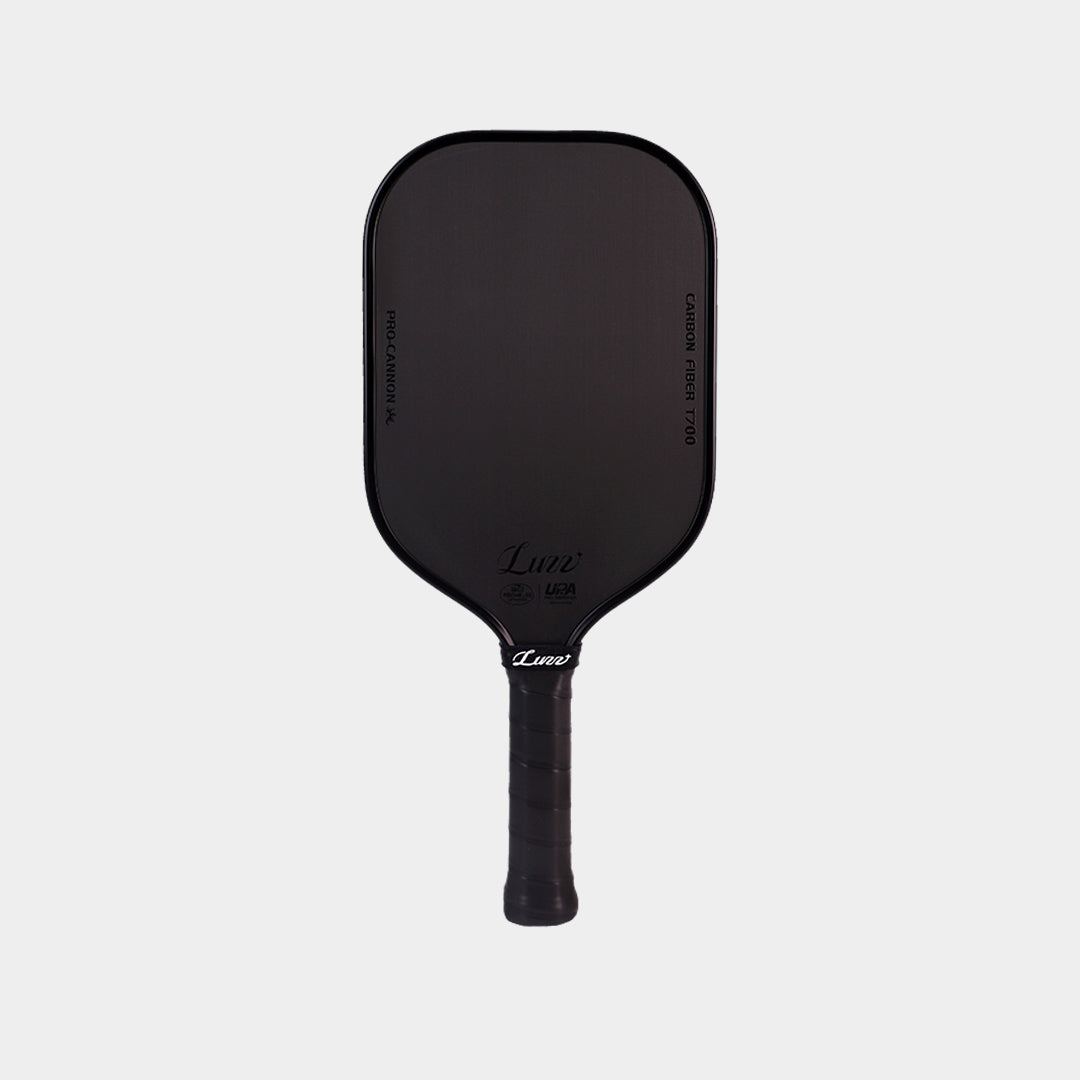
I drill with the same paddle I play with - a Luzz. The Cannon has been dialed in for exactly this soft-hands, reset-heavy game, and hundreds of wall reps a week haven't shaken it.
Drill 6: Serve Plus One, Return Plus One
Play out only the first four shots of the point: serve, return, third, fourth - then stop and start the next rep. Serving team scores a point if their third shot lands unattackable (drop in the kitchen or drive below net height). Returning team scores if their return is deep and they take the kitchen line before the third arrives.
Intermediate points are usually decided by shots one through four, yet almost nobody practices them as a sequence. Deep return plus fast feet to the line is worth more rating points than any highlight-reel shot, and this drill gives you 40 or 50 first-four-shot reps in fifteen minutes - more than you'd see in three hours of rec play.
It also fixes the most common intermediate return mistake: hitting a fine return and then watching it while standing in no man's land. The scoring only rewards you if you're at the line. Getting there is the rep.
Drill 7: The Midcourt Ladder
Start both players at the kitchen. After each rally won, the winner takes one step back; play the next rally from there. Win from the baseline and you've climbed the full ladder - now switch roles. Lose a rally and you step forward again.
This progressively loads the hardest skill in the game: playing quality balls while deep in the court and moving. It's a smarter version of grinding transition resets, because the difficulty adjusts automatically to your level - you only face baseline-depth resets after proving you can win from midcourt.
It's also self-handicapping between mismatched partners, which makes it one of the few drills that stays competitive when a 4.5 drills with a 3.5. The stronger player lives at the back of the ladder, the developing player at the front, and both are working at their edge.
How to Fit This Into Limited Court Time
You don't need drill sessions. You need drill minutes. My realistic template as a working adult with a kid's tournament schedule to manage:
Before rec play (15 minutes): one dink game to 11, then 7-11 once each role. You're warm and you've already practiced with more focus than most players manage all day.
One dedicated hour a week with a partner: skinny singles to 11, serve-plus-one for 15 minutes, thirds-with-a-decision to 10, midcourt ladder with whatever time is left.
No partner, no court: 10 minutes of wall resets. It's the only solo practice I've found that noticeably shows up in games.
That's roughly 2 hours a week of real practice. In my experience that beats 8 hours of open play for improvement speed, because open play at most rec sessions means 40 minutes of waiting per hour and zero targeted reps.
Key Takeaways
Drills transfer when they include a target, a score, or a decision - ideally two of the three. Cooperative repetition without pressure mostly trains a game that doesn't exist. Pick two or three drills from this list and run them weekly for a month rather than sampling all seven once; repetition of the drill is what compounds. And if you only remember one thing: skinny singles is the whole game in miniature - when in doubt, play that.
Frequently Asked Questions
How often should intermediate players drill?
Two focused sessions of 45-60 minutes per week is enough to feel a difference within a month. Consistency beats volume - one hour weekly for eight weeks outperforms a single four-hour block once a month.
What's the best pickleball drill to do alone?
Wall resets with a net-height line taped on the wall. Alternate firm counters with soft resets to train pace change, not just hand speed. Ten minutes daily is a few hundred quality reps.
Should I drill or play more games to improve?
Roughly half and half. Drilling builds the shots; games build the decisions. If you already play plenty of rec games, adding one weekly drill hour helps more than adding another play session.
What ratio of my practice should be dinking?
Less than you think - maybe 20 percent, and always with a score attached. Intermediate matches are decided more often in the transition zone and the first four shots than in long dink rallies.
Do these drills work without a coach?
Yes. Every drill here is self-scoring, which is what a coach mostly provides: honest feedback. The score tells you the truth whether anyone is watching or not.