

How to Play Against a Lefty in Pickleball
If you keep losing to left-handed players, it is probably not because they are better than you. It is because everything you have spent months automating - where the backhands live, which way the spin kicks, whether the middle ball is safe - is mirrored, and your habits keep firing anyway. Learning how to play against a lefty in pickleball is less about new shots and more about un-learning autopilot for one game.
Here is the math working against you: roughly one in ten people is left-handed, so you get about nine games of righty-versus-righty reps for every one game against a lefty. Your patterns get grooved against right-handers, then a lefty shows up and quietly collects errors you do not even recognize as forced.
The good news is that the adjustments are simple, most of them start before the first serve, and almost nobody at rec play actually makes them. This is the full checklist: recognition, spin, targets, returns, and what to do when a lefty-righty team stacks against you.
Watch: 7 Strategies To Use When Playing Pickleball With A LEFTY - ft. Tanner Tomassi
Notice the Lefty Before the First Point
Most players discover their opponent is left-handed somewhere around 5-3, usually while wondering why their safe middle dinks keep coming back as putaways. Every pro who teaches lefty strategy - Zane Navratil dedicated a whole video to it with lefty pro Max Freeman - starts with the same almost insultingly basic tip, and they start there because everyone skips it: look at which hand is holding the paddle.
Make it a pre-game habit. During warm-up, check both opponents' paddle hands, and say what you find out loud to your partner: "lefty, right side." Saying it matters, because your partner is running the same righty autopilot you are, and one of you noticing does nothing if the other keeps feeding the lefty's forehand all game.
Then keep noticing. Recognition is not a one-time event - every third shot decision, every dink target, every speed-up lane depends on remembering which hand you are playing against. In my experience the mistake is rarely "I never noticed." It is "I noticed, then forgot the moment the rally got fast."
Why Lefties Feel So Awkward to Play
The lefty problem is a mirror problem. Nothing they do is objectively harder - it is all just flipped, which means your reads are not wrong by a lot. They are wrong by a little, every single time, and that is worse.
The slice that normally drifts toward your backhand now drifts toward your forehand sideline. The forehand you expect in the middle is a backhand, or the other way around depending on which court they take. The angle you have learned to close down on speed-ups opens the other direction. Your body has thousands of reps of pattern recognition, and against a lefty most of it produces answers that are subtly off.
That is also why lefties feel streaky to play against: the first few games you donate points while your brain recalibrates, and by the time you have adjusted, the session is over. Next month you face another lefty and start from scratch. The fix is not more lefty reps - you cannot conjure left-handed opponents on demand. The fix is going in with a conscious checklist instead of waiting for your instincts to catch up.
The Middle Is Not Automatically Safe Anymore
Against a standard righty-righty team, the middle ball is the percentage play: it usually finds a backhand, it creates who-takes-it confusion, and it takes away angles. Against a team with a lefty, you have to check which version of the middle you are facing before you trust it.
If the lefty is on the right court and the righty is on the left court, both forehands are in the middle. This is the setup lefty-righty teams want, and good ones will stack to keep it all game. Your comfortable middle dink or middle drive is now feeding two forehands - the worst target on the court. Move your targets to the outside: sidelines, feet, and the body of whichever player is weaker.
If the lefty is on the left court, both backhands are in the middle, and the middle becomes a gift. Hammer it relentlessly until they prove they can handle it.
One wrinkle from Zane and Max's breakdown: even when both forehands are in the middle, two players who both want the ball can be as confused as two players who both do not. A low, dead middle ball that forces a decision still has value - just do not attack into that middle with pace, because pace feeding a forehand comes back faster than it left.
Respect the Mirrored Spin
Lefty serves and drives curve the opposite way from what your body expects. The sidespin serve that would normally pull you toward the middle now drags you wide; the drive that normally tails into your body tails away from it. None of this is exotic - it is the same spin you see every day, mirrored - but your feet position themselves off prediction, and their prediction database is full of righty data.
Zane's observation about amateur players is blunt: most people do not lose to lefty drives because the drives are great. They lose because they recognize what is happening too late. The ball is already past them by the time their brain flags the curve as wrong.
The practical adjustment: for the first few points, give every ball an extra half step of room in the direction of the curve and let it come to you. Play your first couple of returns conservative and deep rather than trying to do something with a spin you have not calibrated yet. In my experience the recalibration takes a game or two if you are consciously watching for it - and the whole session if you are not.
Return Deep and Beat the Stack
Lefty-righty teams love drive-and-crash patterns, with the lefty poaching through the middle off their partner's drive. If you have ever played a decent lefty-righty pair, you know the feeling of hitting a fine third shot and watching a lefty forehand appear out of nowhere to end the point.
Two antidotes, straight from how the pros attack this. First, return quality: deep, unattackable returns take the crash away, because nobody poaches effectively off their shoelaces. A short return is an invitation for the drive-and-crash to run exactly as designed. Second, go behind the poacher every few points. A return or third shot placed behind a crashing lefty - into the space they just vacated - does not need to win the point. It needs to plant doubt, because a poacher who hesitates is half as dangerous.
And when they stack to keep both forehands in the middle, use the return to tax it: returning to the open court forces the stacked player to run further to recover, and a stack that has to sprint into position every rally starts leaking errors. You do not have to beat the stack every point. You have to make it expensive.
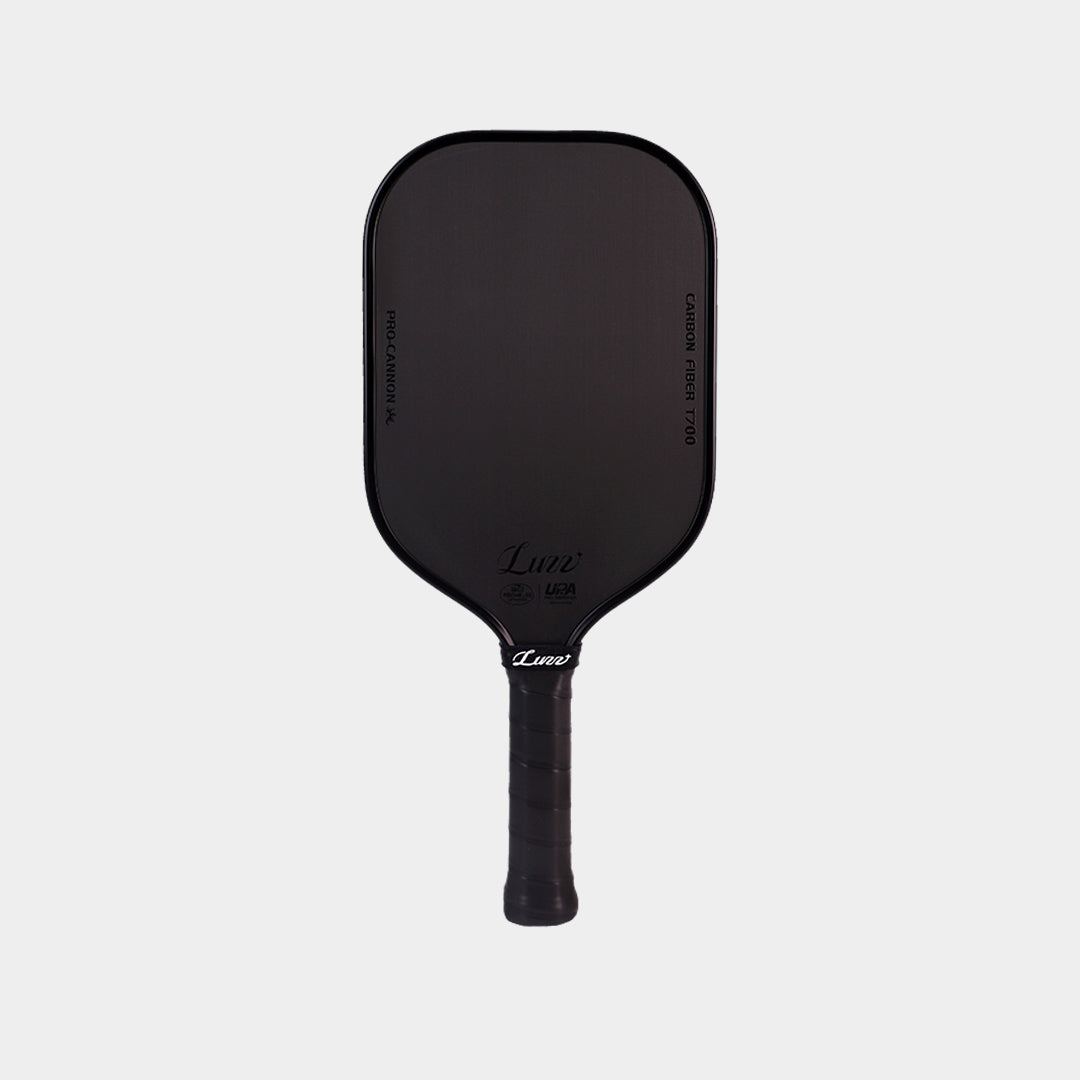
Placement games like this are where paddle control earns its keep. I have been playing with the Luzz Cannon, and the dink feel and reset control make it a lot easier to hit small targets like an inside foot instead of just rallying. Solid build for the price.
Dink at the Inside Foot
At the kitchen line, the best dink target against a lefty flips along with everything else. The general rule from Zane and Max's session: when the lefty is retreating from the line, or you have earned an offensive dink, attack the inside foot - the foot closer to the middle of the court. Against a lefty in the right court, that inside foot sits under their backhand-side hip, and a good aggressive dink there forces the weakest reply they own: a stretched backhand dig from their shoe tops.
Their putaway patterns mirror too. A lefty overhead or high putaway tends to get pulled across their body the opposite way from what you brace for, so when you pop one up (it happens), do not reflexively shade the way you would against a righty - you will be sliding directly into the target zone.
The theme by now should be obvious: every automatic answer you have needs one beat of "wait, lefty" applied to it - including your hands battles, where the lefty's angles open the opposite way. If your counters are the weak link there, see our article on how to counter a speed up in pickleball.
If You Cannot Beat Them, Partner With Them
Everything that makes a lefty miserable to play against makes them excellent to play with. If you get the chance, put the lefty on the right court so both forehands share the middle - the same forehands-in-the-middle setup that just tormented you, now working for you. Suddenly every opponent middle ball finds a forehand, both of you can speed up through the middle lane, and their "safe" targets disappear.
The one thing you have to solve in advance is the middle ball, because two forehands that both want it is its own failure mode. Decide before the game who takes the middle - by calling it, by defaulting to the stronger forehand, or by giving it to whoever is cross-court from the ball. A lefty-righty team that has had that one conversation is genuinely one of the most unpleasant matchups in rec pickleball. I say that as someone who has been on the wrong side of it plenty of times.
Key Takeaways
Beating a lefty is a discipline problem, not a talent problem. Check the paddle hand before the first point and announce it. Re-check where the forehands are before trusting the middle. Give the mirrored spin an extra half step until you calibrate. Return deep, go behind the poacher, and make the stack run. Dink the inside foot. None of these adjustments is hard - what is hard is remembering to make them while your habits scream the righty answer. Run the checklist and the lefty advantage mostly evaporates.
Frequently Asked Questions
Why are lefties so hard to play against in pickleball?
Because only about one in ten opponents is left-handed, your pattern recognition is trained almost entirely on right-handers. Every read - spin direction, backhand location, safe middle targets - is mirrored against a lefty, so your instincts produce slightly wrong answers all game.
What side should a lefty play in pickleball doubles?
Most lefty-righty teams put the lefty on the right court so both forehands cover the middle. This maximizes middle coverage and attacking options, which is exactly why teams stack to keep that alignment.
Where should you serve against a lefty?
Target the backhand, which is the mirror of your usual target. Watch where they stand: many lefties shade to protect the backhand side, so serve into whatever gap they leave, and mix in body serves to jam the decision.
How do you beat a lefty-righty team?
Find where the two backhands are and attack there, keep returns deep so the poacher cannot crash, occasionally play behind the poaching player to keep them honest, and make a stacking team recover long distances after every serve. Avoid feeding pace into a middle covered by two forehands.