

The hard part of the tennis to pickleball transition is not learning pickleball. It is that tennis already handed you a set of reflexes that work brilliantly for about three weeks, carry you past most 3.5 players, and then turn into the exact thing better players aim at. Five habits do most of the damage. Three are mechanical, two are strategic, and not one of them is really "your backswing is too big."
You have heard the backswing advice. Every coaching short says it, and the coaches who say it will admit it is the line everybody repeats. It is true and almost useless on its own, because a long backswing is a symptom. The cause is that you are preparing for a shot on the schedule tennis gave you, on a court that hands you a fraction of that time.
I never played tennis. No racket sport background at all, which means I built every one of these shots from zero and spent a long stretch standing on the other side of the net from tennis converts in Austin open play. That is the angle here. Most articles about pickleball for tennis players are written by coaches telling you what to fix. This one is written by the guy who had to figure out where to aim. It turns out to be the same list.
Watch: Building Forehand Drive part 2 - Backpaddle Pickleball
The Real Reason Tennis Players Struggle at Pickleball
A pickleball court is 44 feet long. A tennis court is 78. In doubles you are responsible for half of the smaller one, which means most points ask you for two or three steps, not a baseline sprint.
That sounds like it should make everything easier, and for the first few games it does. The problem shows up at the kitchen. When both teams are at the line, you are standing about 14 feet from the person hitting at you. A ball that leaves their paddle soft arrives in a blink, and a ball that leaves it hard arrives before your arm has finished going backward.
So the constraint is not swing size. The constraint is time, and every habit below is a time habit wearing a technique costume. Once you see it that way, the fixes stop feeling like you are being asked to throw away twenty years of tennis. You are being asked to shorten the runway, not change the plane.
Habit 1: Your Continental Grip Leaves Your Strong Side Open
Most tennis players arrive holding the paddle like a hammer, in a continental grip. It is a reasonable default and plenty of good pickleball players use it. It also creates a specific, scoutable hole.
With a hammer grip, the paddle face naturally opens toward your off-hip. Balls driven at that side are easy for you. The opposite is not true. Defending a ball at your dominant shoulder from that grip asks for a lot of wrist to open the face and deflect it back, and under speed that wrist does not show up.
This is not theory about you, it is how your opponents already pick targets. When I get drawn against a tennis convert, I am not aiming at the backhand out of habit. I am watching one hand-check at the kitchen, and if the paddle is sitting in a hammer, the speed-up goes at the dominant shoulder. It is the one ball where a strong player's hands suddenly look average.
The fix is not necessarily to abandon continental. It is to know that the shoulder is the hole and to pre-load for it: a slightly more neutral grip, paddle tip up and tracking the ball, and a conscious expectation that the attack is coming high and inside rather than wide. If you want the full grip breakdown, I covered the options in my guide to how to hold a pickleball paddle.
Habit 2: The Cocked Wrist Ready Position
Watch a tennis player wait for a volley and the wrist is cocked, forearm and racket making something close to a 90-degree angle. That is a good tennis position. It is a bad default at a pickleball kitchen line.
Count the shots you actually hit from the kitchen. Dinks, reach-in roll volleys, flicks, tip-down dinks, resets off your shoelaces: nearly all of them happen below your wrist. There are maybe one or two shots up there that genuinely want the wrist cocked. Defaulting to the position that serves two shots means you spend the rest of the point rushing the paddle down from the wrong place.
Flip the default. Flat wrist, paddle out in front, and add the wrist cock at the last moment on the rare ball that needs it. Adding a position late is fast. Escaping one is slow. I wrote a whole piece on pickleball ready position if you want the detail, but the tennis-specific version of the note is just this: your hands are probably fine. Your starting point is costing you the first four inches of every exchange.
Habit 3: The Windshield-Wiper Forehand
Here is the technical one that almost nobody labels as a tennis habit, which is exactly why it survives so long.
The imported pattern is an arm that starts out to the side of the body and then rolls heavily through contact, forearm turning over like a windshield wiper. It produces real topspin and real pace in tennis. In pickleball it produces a ball with a huge margin for error, because the face is changing angle fast at the exact moment it meets a plastic ball that does not compress.
The pickleball version is closer to bowling. The arm travels linearly, straight down the target line, and the face stays stable through contact.
The part that confuses people is that pros clearly do finish across the body and over the shoulder. Watch it frame by frame and the finish is a consequence, not an action. The wrist lays back a little and stays firm, the elbow barely does anything, and the shoulders rotate a lot. The rotation is what carries the arm around. The arm itself went straight and then curled up.
You give up some power with the linear path. What you get back is the ball landing in the same place twice, which at 4.0 is worth considerably more. My article on how to hit a drive in pickleball walks through the same motion from a coaching session.
Habit 4: You Are Telegraphing Everything
Tennis rewards complete preparation. The racket goes back, the shoulder turns, and nobody punishes you for announcing the shot because the ball has 60 feet to travel.
At a pickleball kitchen line, your preparation is the announcement. A big take-back does not just slow you down, it tells the other team what is coming while they still have time to do something about it. Coaches name this problem constantly and then move on without teaching it, which is a shame, because it is one of the most fixable things on this list.
The fix is a single start position that serves three different shots. The dink, the roll, and the speed-up should all begin from the same place, with the same paddle height, and the same amount of nothing happening behind you. Let the difference live in the last few inches: paddle face and wrist speed, not the size of the windup.
Drill it in pairs. Have a partner feed you the same dink ten times and commit to the same preparation on every one, choosing at the last moment whether to dink it back, roll it, or lift it. If they can call your choice before you hit it, your preparation is still doing the talking.
Habit 5: You Treat the Soft Game as a Waiting Room
This is the real transition, and it is the one that takes months rather than weeks.
Tennis teaches you that the point is won by hitting the ball well. Pickleball frequently asks you to hit the ball badly on purpose: a third shot drop that dies, a reset off a hard drive that just gets the ball over and low. Tennis converts tend to treat these as filler, something to survive until a real shot appears. So the drop gets hit with 70 percent intent, the reset gets a firm paddle, and the ball pops up.
The reframe that matters: the soft game is not defense. It is how you take time away from the other team. Every ball you make them hit from below the net is a ball they cannot attack, and a point you are slowly winning without ever hitting anything impressive.
Practically, this means spending your practice time in the least satisfying places on the court. The third shot drop and the reset are where converts gain the most ground the fastest, and both are habits of touch rather than strength, which is why raw athleticism does not shortcut them. I covered the mechanics in my pieces on the modern 3rd shot drop and how to reset in pickleball.
Keep This: Your Drive Is Genuinely a Weapon
Now the other half, because the standard advice to tennis players is a list of things to delete and that is bad advice.
Your drive is better than almost everyone's at your level, and most 4.0 players cannot handle a well-struck one. They block too hard, their paddle face is doing too much, and the ball pops up. That is a free point you own on day one.
Do not sand it down in the name of learning the soft game. Learn to pick the right ball for it. The drive works best off a short, high return and against a team that is still moving forward, and it works badly as a reflex answer to everything. If you want the honest version of when to use it, my framework for the drop or drive decision is the piece I would read.
Keep This: Your Movement Base, Scaled Down
Tennis gave you a split step, a recovery habit, and the ability to move without thinking about it. Those are real, and plenty of players who have only played pickleball never develop them.
The adjustment is scale. Tennis movement is large, and here it overshoots. Two steps covers most of what you need, and the biggest unforced error I see from athletic converts is arriving at the ball with too much momentum and hitting through it rather than settling and absorbing. Smaller steps, more of them, and a genuine stop before the paddle moves. My notes on pickleball footwork go through the specific patterns.
Keep This: You Already Know How to Build a Point
Pattern play transfers almost perfectly. Moving someone side to side, attacking a weaker partner, changing pace to break rhythm, finding the body on a jammed ball: tennis taught you all of it, and most recreational pickleball players have never thought about any of it.
In my experience this is the most underrated thing converts bring. The shots take months. The strategic sense arrives already working. If you are losing to players with worse hands than yours, it is usually not because your tactics are wrong, it is because one of the five habits above is leaking points before your tactics get a chance.
The Paddle Mistake Almost Every Convert Makes
Walk into a pro shop from tennis and you will reach for an elongated paddle. Longer handle, longer face, feels like a racket in your hand. It is the single most common first purchase for converts and it is usually chosen for familiarity rather than performance.
Elongated is the most used shape on tour, and that fact gets quoted as if it settles the question. It does not, partly because a large share of touring pros are former tennis players too, so the tour's preference carries the same familiarity bias you do. Elongated buys reach and plow-through and costs you twitch speed and forgiveness off-center, which are the two things a convert needs most while the hands catch up.
Try a wider shape before you commit. The standard advice from converts who have switched is that they kept their natural power from the back of the court and gained the control and hand speed they were missing.
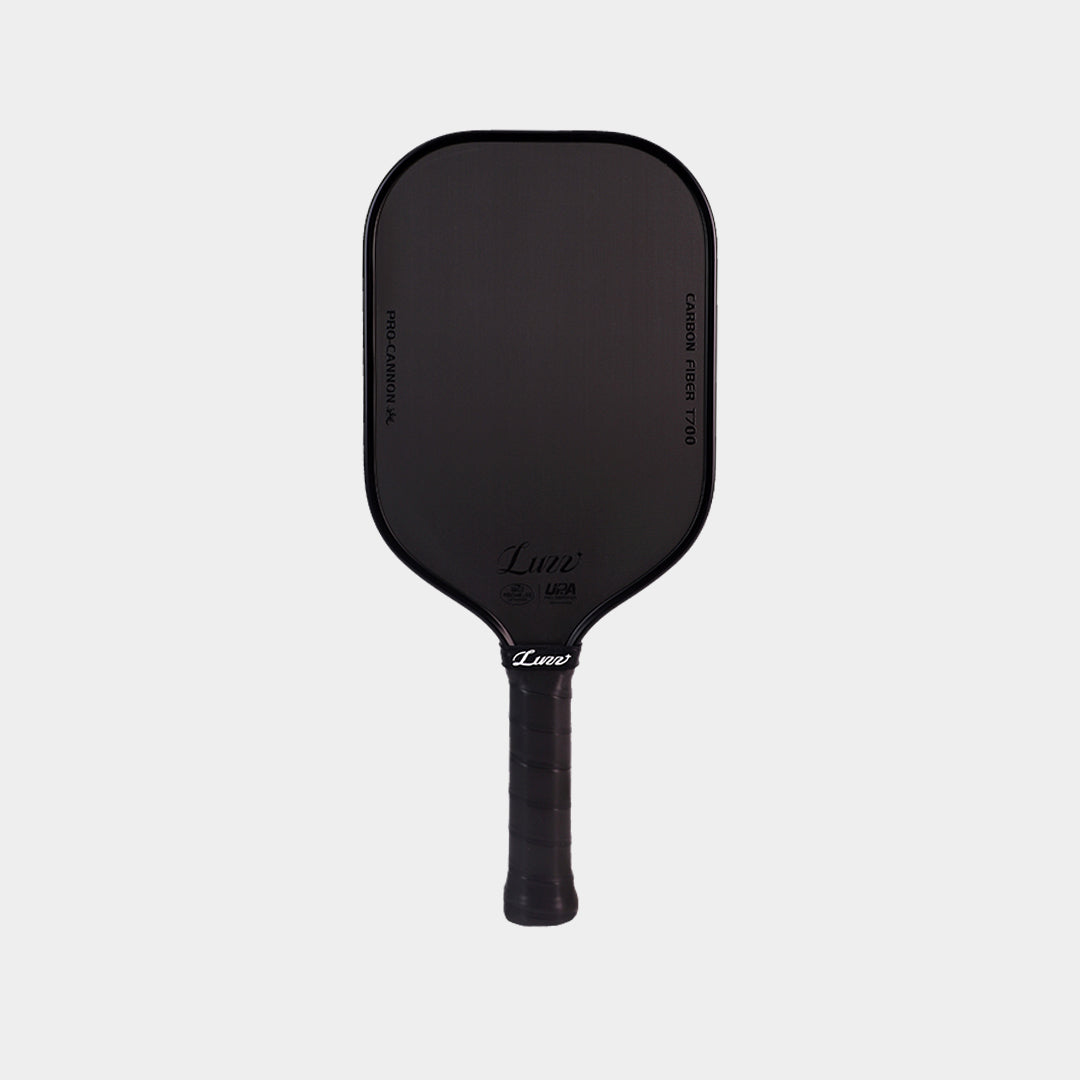
The paddle I have been playing is from Luzz. The Cannon has the kind of face feedback that actually tells you whether you brushed the ball or pushed it, which matters a lot when you are rebuilding a stroke path rather than just swinging harder. Solid build for the price.
Your First Six Weeks: What to Actually Practice
If you only have a few sessions a week, spend them in this order.
Weeks one and two: ready position and grip. These are free. You are not learning a skill, you are changing where you start, and the gains show up immediately in firefights.
Weeks three and four: the third shot drop and the reset, in that order, from a stationary feed. Boring, and the highest-leverage practice available to you. Do not progress to moving feeds until the stationary ones land below the net consistently.
Weeks five and six: identical preparation on dink, roll and speed-up, with a partner trying to call your shot before you hit it. This is where the telegraphing habit dies.
Leave the drive alone. You already have it, and practicing what you are already good at is the most comfortable way to not improve. For structured options, I keep a list of pickleball drills for intermediate players, and if you are short on partners there is a version you can do by yourself in my piece on pickleball drills you can do alone.
Key Takeaways
The tennis to pickleball transition is a time problem, not a technique problem. Your grip, your ready position, your forehand path and your preparation all assume you have more time than a 44-foot court is going to give you, and better players will find each of those before they find your backhand. Fix the two free ones first, because grip and start position cost nothing but attention. Then spend real practice time in the soft game, which is the only item on the list that athleticism will not shortcut. And keep the drive, the movement and the point-building instincts, because those are the reason you will pass players who have been at this longer than you have.
Frequently Asked Questions
How long does the tennis to pickleball transition take?
The mechanical habits change inside a few weeks because they are mostly about where you start rather than what you can do. The soft game takes months. In my experience converts become difficult to beat quickly and then stall for a while at exactly the point where the drop and the reset start deciding points.
Is a tennis background an advantage in pickleball?
Yes, on balance, and more than converts tend to believe once they start losing to people they expect to beat. You arrive with a weapon off the bounce, real movement, and tactical sense most recreational players never develop. What you also arrive with is five habits built for a court with twice the distance.
Should tennis players use a continental grip in pickleball?
You can, and plenty of strong players do. Just know that it opens your paddle face toward your off-hip and makes the ball at your dominant shoulder harder to defend, which is where experienced opponents will attack. If your hands feel slow on high inside balls, that is the grip, not your reflexes.
Do tennis players need a different paddle shape?
Not need, but most converts should at least try a wider shape before buying elongated. Elongated feels familiar because it resembles a racket, and the familiarity gets mistaken for fit. A wider face is more forgiving off-center and quicker in hand battles, which is where converts lose the most points early.
Why do tennis players lose to weaker pickleball players?
Almost always because the soft game is treated as a waiting room. If every ball below the net is something to survive rather than a way to take time away from the other team, a patient 3.5 who can dink all day will out-wait a much better athlete, and will do it without hitting a single impressive shot.
Keep reading
- How to Stop Getting Stuck in the Pickleball Transition Zone - Tennis instincts keep you hanging at the baseline or charging too fast; this is how to move forward on purpose.
- Why You Keep Popping Up Your Dinks - The soft game is where converts stall, and the popped-up dink is the first thing that gives it away.
- Two-Handed vs One-Handed Backhand - If you hit a two-hander in tennis, here is when to keep it and when to let it go at the kitchen.