

How to Block a Drive in Pickleball: Your Paddle Is Doing Too Much
Learning how to block a drive in pickleball is mostly a process of learning to do less. The players who defend hard balls well are not faster than you. They are quieter than you. Their paddle is already where it needs to be, their hand is soft, and they let the ball's own pace do the work of getting it back over the net.
Here is the thing nobody says out loud at rec level: a hard drive is the easiest ball in pickleball to return and the hardest ball to return well. Getting a paddle on it is not the problem. Getting it back down is. If your blocks keep floating up to chest height and coming back at you twice as fast, you do not have a reaction problem. You have a paddle that is doing too much work.
This article covers the four things that actually decide whether a block drops dead in the kitchen or gets buried: grip pressure, where the paddle lives before the ball arrives, contact point, and where you aim. It also covers the part people skip, which is that most drives beat you before they are even struck.
Watch: Defending Strong Drives - Backpaddle Pickleball
The Block Is Not a Shot You Hit
Start here, because every other fix follows from it. A block is not a swing. It is a surface you present.
When someone drives at you from the baseline, the ball arrives carrying all the energy it needs to get back over the net and then some. Your job is to take energy off it, not add more. The moment you swing, punch, or push at it, you are adding pace to a ball that already had too much, and the result is a ball that clears the net by three feet and sits up at waist height for the other team.
That is the whole counterintuitive core of this shot. On almost every other ball in pickleball, doing more helps. On a block, doing more is the error.
Think of it like catching an egg. You do not stab your hands out at an egg. You meet it and give with it. The paddle is the same: it meets the ball in front of you and absorbs, and the ball dies. Everything below is just detail on how to make that happen under pressure.
Why Your Blocks Keep Popping Up
There are really only three causes, and they show up in combination.
Grip pressure. A tight grip turns your paddle into a wall, and a wall is a trampoline. The ball comes off fast and high because none of the energy got absorbed anywhere. This is the single biggest cause and it is almost always worse in a real game than in drills, because pressure makes people squeeze.
Contact behind the body. If the ball gets past your hips before you touch it, your paddle face has to open up to reach back and lift it. An open face plus real pace equals a floater. You physically cannot block down on a ball you let get behind you - it is the same mechanism that causes the dinks that sail on you, just at four times the speed.
Punching. Some players know not to swing, so instead they jab the paddle forward at the last second. It feels controlled. It is not - it is a small swing with worse timing. Any forward movement of the paddle at contact adds pace.
If you want to diagnose which one is yours, film thirty seconds of hands battles on your phone. In my experience most people are shocked at how far back their contact point is and how much their paddle is moving at the moment of impact.
Grip Pressure Is Most of the Shot
If you fix nothing else, fix this.
On a scale of one to ten, your grip at the kitchen should sit around a three or a four. Firm enough that the paddle does not twist when a hard ball hits the edge of the face, loose enough that the handle can move slightly in your hand at contact. That small amount of give is where the pace goes.
The problem is that grip pressure is not a static setting. It creeps. You start a game at a four, somebody drives one past your ear, and by the middle of the second game you are at an eight without noticing. Then every block you hit sails.
Two things that help. First, a physical reset: between points, let the paddle hang loose from your fingers for a second and re-take the grip. It sounds trivial and it interrupts the creep. Second, a cue you can run mid-rally - I think soft hands, hard feet. Feet working, hands doing nothing. If your grip is not something you have ever deliberately set, it is worth reading the full grip guide first, because pressure and grip style interact.
One caveat worth being honest about: a very loose grip on a very hard ball will twist the paddle if you are hitting off-center. If your blocks are spraying sideways rather than popping up, you may have gone too far the other way. Three to four, not one.
Paddle Position: In Front, and Higher Than You Think
You cannot absorb a ball you have to reach for. So the paddle has to already be in position before the drive is hit, not after.
The default ready position most rec players hold is a dinking position - paddle low, tip pointing down, hands around the waist. That is correct for a dink exchange and it is dead wrong when a drive is coming. From a low paddle, the only way to reach a ball at chest height is to lift the whole arm, which is slow and which opens the face on the way up.
Against a driving team, hold the paddle up: tip above the wrist, paddle head somewhere between your sternum and your chin, both hands near it, elbows in front of your ribs rather than pinned to your sides. From there, the shortest path to almost any ball is a small turn of the shoulders, not a swing.
The reason this works is geometry. A drive at the kitchen line gives you roughly a third of a second. That is enough time to rotate a paddle that is already up. It is not enough time to raise one that is down. The players who look like they have fast hands mostly just started from a better place - you should be set up for the attack, not the dink.
Contact Point: In Front, Where You Can See It
Every block should happen in front of your body, inside your field of vision.
Out front, you can see the paddle face, so you know what angle you are presenting. The ball has less time to build speed after the bounce. And your body naturally absorbs rather than reaches. Behind the body, none of that is true - you are guessing at the face angle and lifting.
The practical cue: if you had to move the paddle backward at any point, you were late. Against fast hands you will be late sometimes, and the correct response to being late is not a faster swing. It is to give ground. Take a small step back so the ball lands in front of you again, and block from there. A block hit from a step back with good contact is better than a block hit on time with the ball on your hip.
On the body jam specifically - the drive aimed straight at your paddle-side hip - the fix is a quick move of the paddle to the backhand side and a hip rotation out of the way. That one is common enough at rec level that it has its own name, the chicken wing, and it is worth drilling separately.
Where to Aim: Three Targets, in Order
Once the ball is coming off your paddle under control, aim it somewhere. Most rec blocks have no target at all, which is why they end up in the middle of the court at a comfortable height.
1. Their feet, at the kitchen line. This is the default and it is the best one. A ball at the feet of an opponent crashing in behind their drive is the shot that ends the pattern. They are moving forward, the ball is below their knees, and they have to hit up on it. That is how a defended drive turns into your attack two balls later.
2. The middle seam. Against two players who are both rushing in, the block down the middle creates the hesitation. Neither is sure whose ball it is, and the one who takes it takes it late. If your own team has never settled that question, who takes the middle is worth agreeing on before it costs you a game.
3. Short and cross-court, away from the driver. If the person who drove is still in the transition zone, a soft block angled short and cross-court forces them to hit a difficult low ball while still moving. This is the highest-skill option and it is the one to add last.
What is not on the list: blocking back hard at the driver. Trading pace with someone who is set up to drive is a rally you lose more often than you win.
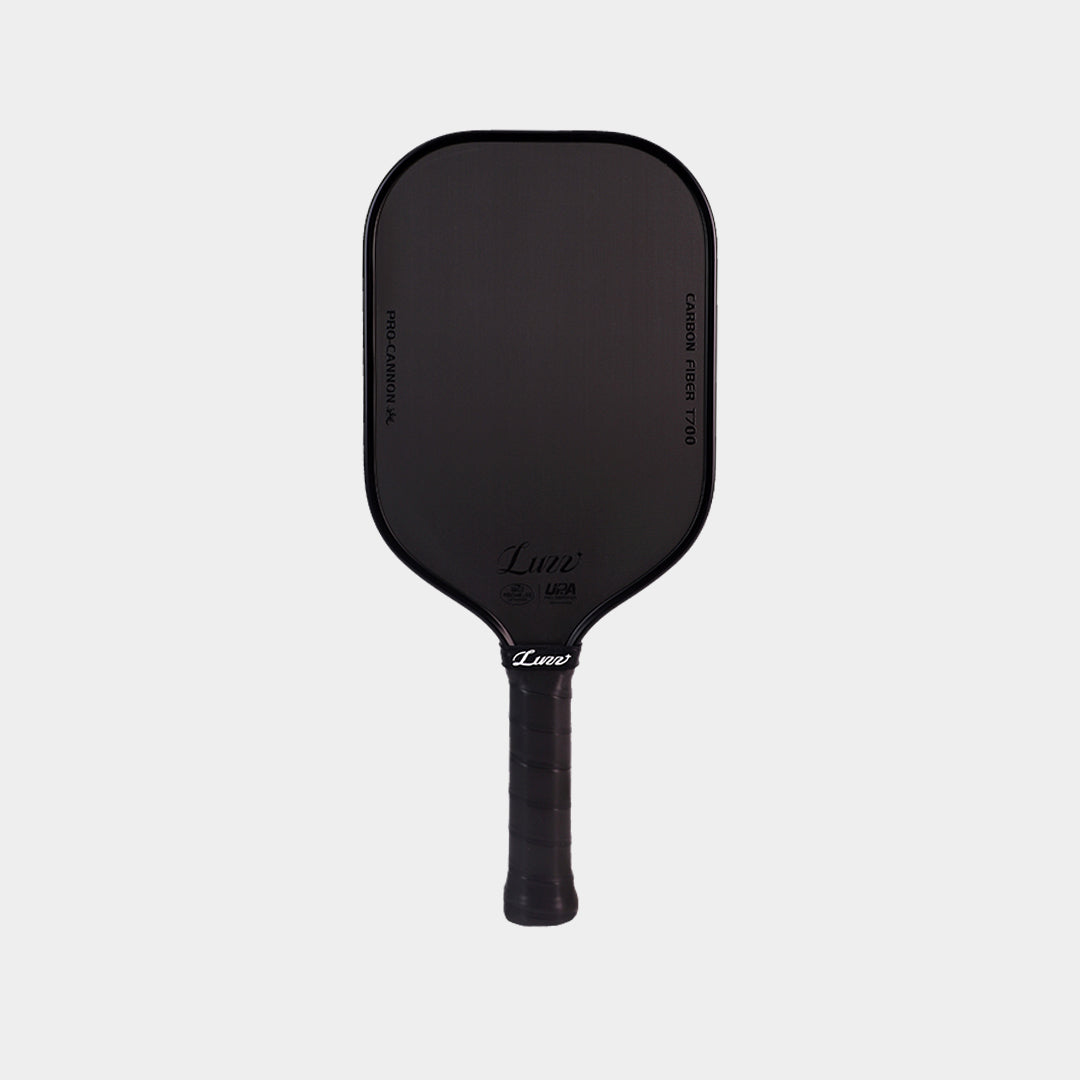
Blocking is the one shot where paddle feel is not a preference, it is the mechanism. You are trying to absorb pace, and a paddle that reports back what happened on contact is what teaches your hand how soft to be. I have been playing a Luzz paddle, and the thing I noticed on hard counters was how much feedback comes through the handle - off-center hits feel different from clean ones, which is exactly the signal you need to fix a block.
How to Block a Drive in Pickleball at the Kitchen Line vs in Transition
These are two different shots and people conflate them.
At the kitchen line, you have almost no time and you do not need to move. Paddle up, soft hands, contact in front, target their feet. Your feet stay planted and split. Do not back up off the line to give yourself more time - backing off the kitchen line against a driving team is how you end up stuck in no man's land for the rest of the point.
In the transition zone, you have slightly more time but much worse balance, because you are usually moving forward. Here the shot is really a reset with more pace on it: get low, get the paddle out front, and aim to land the ball in the kitchen rather than at anyone's feet. The priority is the ball dying short, not the ball being uncomfortable. Take the extra half step to get your body stopped before contact if you can - a split step before the ball is struck is worth more than a faster hand after it, which is true of most of the shots you think you are missing because of your hands.
The mistake that costs the most points is using the kitchen version of the shot from the transition zone. Blocking flat and firm while moving forward through the middle of the court sends the ball right back into the strike zone of someone who is already at the line.
Defending Starts Before They Hit It
Here is the part that technique articles leave out. A lot of the drives that beat you were unblockable by the time they were struck, and the error happened earlier.
Two things to watch. The first is your return depth. A short return gives the driving team a ball they can step into and hit from inside the baseline, which cuts your reaction time roughly in half. Deep returns are not just about pinning them back; they are about buying yourself the tenth of a second that makes a block possible.
The second is reading the driver's contact point. You can tell a lot before the ball leaves their paddle. Ball above their waist with the shoulders turned means a real drive is coming - get the paddle up and widen your base. Ball below their knees or taken on the move means a drop or a soft ball is far more likely, and you can stay in a dinking posture. Rec players tend to hold one posture for the whole point, which means they are either over-prepared for dinks or under-prepared for drives, and against a banger it is always the second one.
And the honest strategic note: if one player on the other team drives everything and the other does not, the block conversation is only half the answer. The other half is not giving the driver the ball, which is a targeting and return-placement problem rather than a technique one.
Two Drills That Build a Block You Trust
Progressive pace. Partner stands at the kitchen line opposite you and feeds firm volleys at maybe sixty percent. You block everything, aiming at their feet, paddle never moving forward. Every ten balls they add pace. The rule is that you stop the drill the moment your blocks start popping up, and you drop back a level. You are training the grip pressure, not the reflex - if you never fail, the drill is too easy; if you fail constantly, you are just rehearsing the pop-up.
Drive and block. Partner drives from the baseline, you block from the kitchen, and the point plays out. This is the one that transfers, because it includes the two things the feed drill removes: a real bounce off a real drive, and the driver crashing the net behind it. Play it to eleven and count how many of your blocks landed in their kitchen versus above their waist. That number, tracked over a few sessions, will tell you more than any cue.
If you are on your own, a wall works better than people expect. Stand close, hit firm, and block the rebound with a completely passive paddle. The wall will not let you cheat - if the paddle moves forward at all, the ball comes back too high and too fast, immediately.
Key Takeaways
Learning how to block a drive in pickleball comes down to subtraction. Soft grip around a three or four, paddle up and out in front before the ball is hit, contact inside your field of vision, and zero forward paddle movement at impact. The ball has all the pace it needs already.
Then give the shot a job. Aim at the feet of whoever is crashing in, or at the middle seam between two players who are both moving. And remember that the drive that beat you was often set up by a short return or a posture you never changed - defending well starts a shot or two before the block itself.
Frequently Asked Questions
How do you block a hard drive in pickleball without popping it up?
Loosen your grip to about a three or four out of ten, get the paddle up in front of your chest before the ball is hit, and make contact in front of your body with the paddle completely still. Pop-ups come from a tight grip, a late contact point, or pushing the paddle forward at impact.
Should you block or counter a hard drive?
Block by default. Countering - redirecting a hard ball back with pace - only works when you are balanced, the ball is at or above your waist, and you are set at the kitchen line. Below the waist, off balance, or in the transition zone, the block is the higher-percentage shot.
Where should your paddle be when someone is driving at you?
Tip above the wrist, paddle head between your sternum and chin, elbows in front of your ribs, both hands near the handle. A low dinking-ready position leaves you no time to lift the paddle into a chest-high drive.
Why do my blocks go into the net?
Usually the opposite problem: a face angle that is too closed, or a grip so loose that a hard ball twists the paddle on an off-center hit. Open the face slightly and firm up from a two to a three or four, and aim to land the ball in the middle of their kitchen rather than right at the net.
How do you defend against bangers who drive every ball?
The block is half of it; the other half is placement. Keep your returns deep so they cannot step in and drive from inside the baseline, keep your paddle up throughout the point rather than only when you expect a drive, and aim blocks at the feet of whoever is rushing the net behind the drive.
Keep reading
- How to Hit a Drive in Pickleball - The other side of this shot: if you are the one driving, this is how to hit one that is hard to block.
- Pickleball Ready Position: Prepare to Attack, Not Dink - The paddle-up posture that gives you time to block a drive at the kitchen line.
- Why You Keep Popping Up Your Dinks in Pickleball - Same grip-pressure and contact-point problem, just at slower speed.